Case Study 001 · Productive Landscapes
Edible Landscaping
Turning Decorative Land Into Productive Infrastructure
Distributed food infrastructure
Measured regional pilots
More value per landscaped acre
America devotes enormous resources to landscapes designed to look attractive while producing little direct material value. Edible landscaping begins with a simple question: what if a meaningful share of those same spaces also produced food?
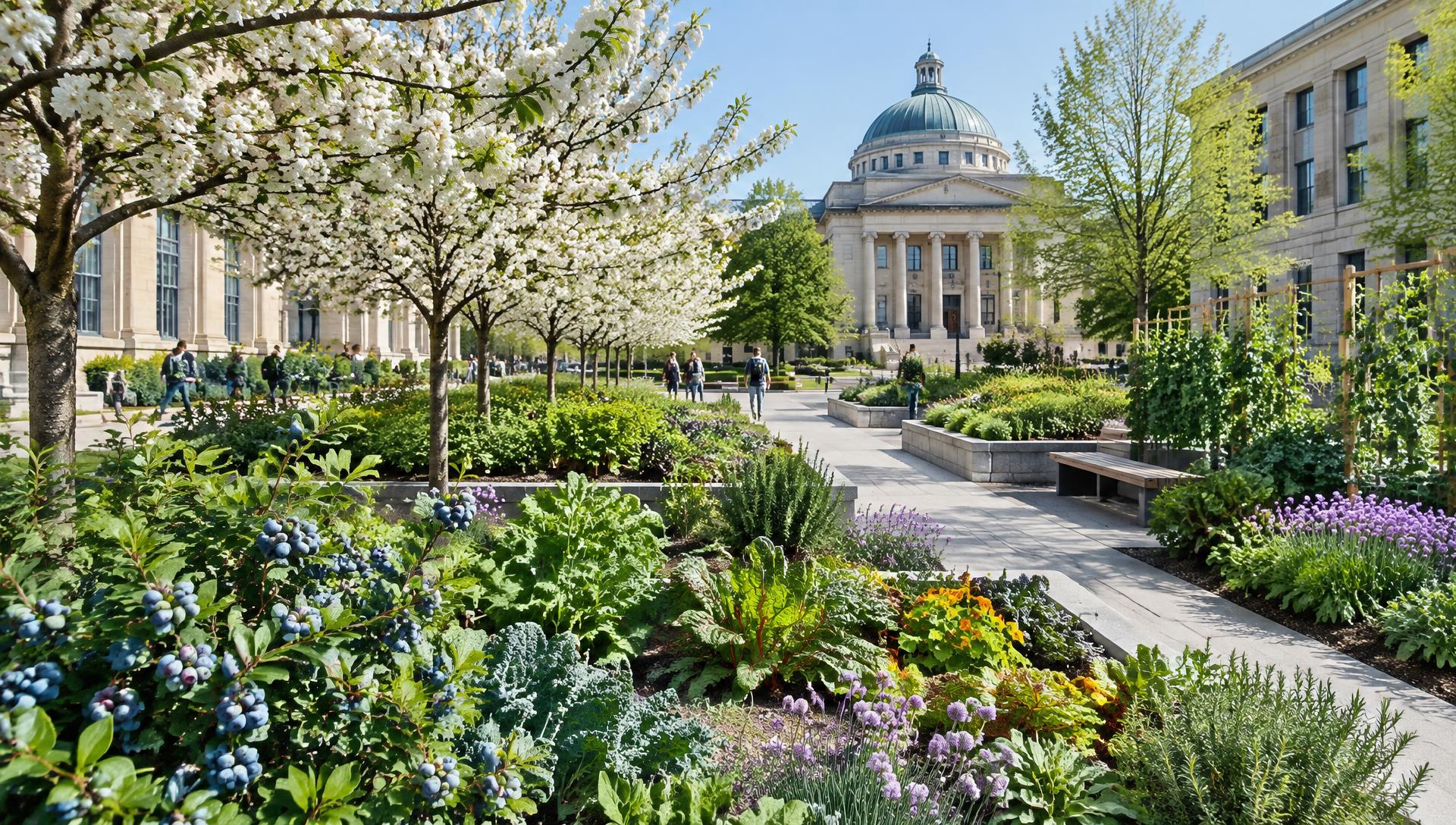
Edible landscaping replaces or supplements purely ornamental shrubs, trees, and groundcovers with species that are both attractive and productive. Fruit and nut trees, berry bushes, herbs, perennial vegetables, edible flowers, vines, and climate-appropriate food plants can perform many of the same aesthetic and environmental functions as conventional landscaping while creating recurring food value.
The objective is not to turn every park, median, campus, subdivision, or civic building into a farm. It is to design landscapes so beauty, shade, habitat, stormwater management, public enjoyment, and food production reinforce one another.
“A more intelligent civilization asks every system to do more than one useful thing.”
01 · Design Principle
Why replace useless shrubs?
Conventional landscaping consumes land, water, fertilizer, labor, fuel, and maintenance budgets while often producing no direct material output. A decorative hedge may be attractive, but a blueberry hedge can be attractive and produce food. A flowering ornamental tree may provide seasonal beauty; an apple, cherry, plum, peach, pear, or citrus tree can provide flowers, shade, habitat, carbon storage, and a harvest.
This does not make every ornamental plant useless. Native habitat, biodiversity, erosion control, shade, and beauty carry real value. The better rule is comparative: where two plants can perform similar landscape functions, prefer the one that creates additional public value.
Ornamental tree
Flowers · Shade · Habitat · Carbon · Structure
Productive tree
Flowers · Shade · Habitat · Carbon · Structure · Food
02 · Living Architecture
Fruit trees are also ornamental
Many fruit trees are among the most visually compelling landscape trees available. Apples, cherries, pears, peaches, plums, almonds, citrus, pomegranates, figs, and other species offer seasonal flowers, changing foliage, architectural structure, shade, wildlife habitat, and colorful fruit.
A street lined with flowering fruit trees can be as beautiful as one lined with conventional ornamentals while producing thousands of pounds of food across its lifetime. Thoughtful cultivar selection can prioritize compact growth, disease resistance, low maintenance, extended bloom, and manageable harvests.
03 · Network Effect
Distributed food infrastructure
Edible landscaping creates a distributed food network rather than concentrating all production in distant agricultural zones. No single site transforms the food system. The power lies in replication across thousands of ordinary sites.
System diagram
Many sites. One resilient network.
Regional plant palettes
Distributed productive sites
Local harvest partners
04 · Scenario Analysis
Potential scale, without false precision
The United States contains tens of millions of acres across lawns, campuses, rights-of-way, institutional landscapes, parks, and residential plantings. Only a fraction is suitable for food production. Yet conversion of even a modest share could yield significant volumes of fruit, nuts, herbs, vegetables, and perennial crops.
Output depends on climate, water, species, soil, maintenance, planting density, and harvest systems. The scenarios below communicate orders of magnitude—not forecasts.
Scenario note: These ranges illustrate possible scale categories. They do not estimate national production and should not be used as forecasts.
05 · Shared Value
Economic value, public health, and community
Productive landscapes can reduce food miles and household food costs while creating demand for nurseries, horticulture teams, harvesting services, food processing, distribution, community markets, and local businesses. Landscaping budgets become, in part, productive infrastructure budgets.
Fresh food also becomes visible and local. Schools can integrate edible landscapes into science and nutrition education. Senior communities and neighborhoods can use them as social spaces. Organized harvesting can route excess food to food banks, kitchens, schools, and local markets.
Ecology
Habitat, soil health, carbon storage
Resilience
Cooling, shade, stormwater absorption
Community
Education, gathering, fresh food
06 · Ecology
Biodiversity by design
Productive does not mean monocultural. Diverse plantings can combine native-adapted species, pollinator plants, perennial crops, shade trees, and living groundcovers within water-conscious designs. The result can strengthen habitat and soil while reducing heat-island effects, absorbing stormwater, and storing carbon.
07 · Operations
Design for maintenance
Edible landscapes create practical challenges: fallen fruit, pests, liability, irrigation, pruning, harvest timing, wildlife, public access, allergies, and maintenance. These are not reasons to ignore the opportunity. They are engineering and operations requirements.
- Choose low-maintenance, disease-resistant cultivars.
- Match crops to climate, soil, access, and each site’s real operating capacity.
- Avoid high fruit-drop species near critical walkways.
- Build organized harvest programs before planting.
- Integrate irrigation and soil monitoring.
- Plan for pruning, crop rotation, and eventual replacement.
- Use robotic or semi-automated maintenance where economical.
- Contract local growers and horticulture teams.
- Measure yield and maintenance cost.
08 · Resilience
Rotational landscape systems
Productive landscapes should not depend on monocultures. Annual beds can rotate; perennial species can be diversified; succession planting can keep spaces active; and staggered harvest windows can spread labor across seasons. Plant palettes should adapt as climate, disease pressure, public use, and operating data change.
Diversity is an operating strategy: it reduces correlated failure and makes the system easier to improve over time.
09 · Advanced Technology
Robotics, AI, and smart landscapes
Edible landscaping can be managed as a data-enabled infrastructure system. Soil sensors and irrigation controls can reduce water waste. Computer vision can identify disease and estimate ripeness. Robotic mowing, harvesting, and targeted maintenance can lower repetitive labor. Yield forecasting can coordinate volunteers, food banks, and local processing.
At city scale, mapping and digital twins could show plant health, water demand, expected harvests, maintenance schedules, and public access—turning scattered gardens into a legible operating network.
Sensors
Automation
Mapping
Digital twins
10 · Governance
A practical policy model
Policy should not mandate production everywhere. It should create a disciplined process for identifying suitable sites, testing alternatives, managing risk, and expanding only after results are known.
- 01Inventory public and institutional landscaping.
- 02Classify sites for edible conversion suitability.
- 03Require new public projects to evaluate edible alternatives.
- 04Establish approved regional plant palettes.
- 05Set maintenance, safety, and accessibility standards.
- 06Create local harvest partnerships.
- 07Track yield, cost, water use, and community benefit.
- 08Expand only where measured results justify it.
11 · First-Year Program
Begin with a measured pilot
A credible first year would prioritize learning over scale: five to ten sites spanning a school, park, civic building, campus, residential community, and commercial property. Each site should use standardized baseline metrics, record twelve months of maintenance, measure yield, gather public feedback, and publish results openly.
Pilot standard
The best-performing models should scale. Weak designs should be revised or retired. The point is not to prove the concept correct in advance—it is to discover where the concept creates enough value to justify continued investment.
12 · The Civilization Principle
Ask every system to do more than one useful thing
A tree can provide shade, beauty, habitat, carbon storage, stormwater benefit, and food. A park can support recreation, education, biodiversity, cooling, and food infrastructure. A landscaping budget can produce both beauty and measurable economic value.
Edible landscaping is not a proposal to turn every city into a farm. It is a proposal to stop designing millions of acres as though productivity and beauty were mutually exclusive.